
Is this beetle doing what I think it’s doing?
The Sisyphean world of dung beetles

Years ago, I read that after gorillas learned to communicate using sign language, we realized they interpret time differently than humans do. When indicating a time in the past, they point in front of them, rather than behind like we tend to. The future, according to a gorilla, is behind you because you can’t see it yet. But in front of you lies the past and all you’ve experienced thus far. It’s genius, really.
Dung beetles may feel the same.
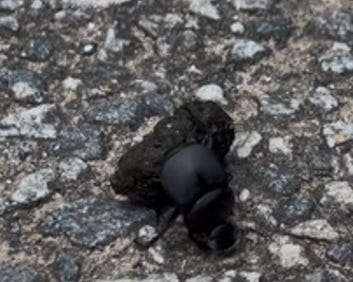
Earlier this week I walked outside with my dog to let him wander around the yard when I caught movement out of the corner of my eye. On our driveway I saw a small, dark ball rolling haphazardly across the asphalt. When I crouched down, I saw a beetle rolling… well, let’s say a chunk of dark matter bigger than itself with its back legs. The beetle was facing backward and rolling this oddly-shaped lump in fits and starts, its past clearly in front of it as it rolled toward the future:
Was this a dung beetle? Honestly, I had no idea those lived here in Georgia – I kind of envisioned them living in Africa and other high desert areas. What did it plan on doing with this lump of dung? Do beetles eat it? Build homes with it?
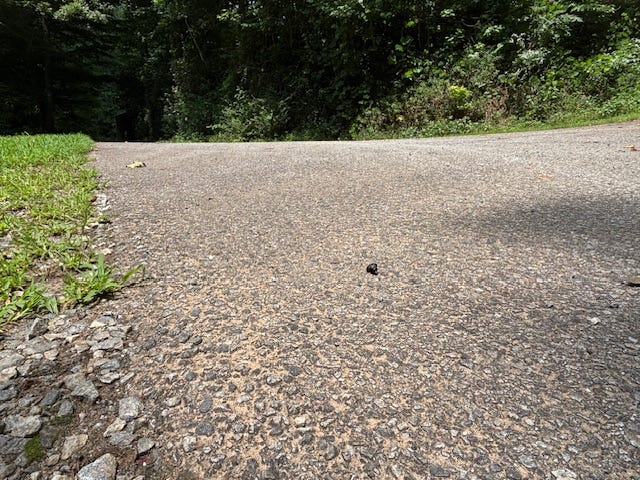
And how far did it plan to go? The future behind this beetle stretched an impressively long way…
Why do dung beetles love dung?
I researched and discovered that I had definitely encountered a dung beetle in my yard. I also discovered that – hello! – I should not have been so surprised to encounter one here in Georgia. Dung beetles live on every continent except Antarctica, and without them we’d be swimming in feces. They are a necessary decomposer that helps rid the planet of all the waste we leave around.
Georgia has dozens of species of dung beetles, including the Rainbow Scarab beetle, a beautiful iridescent beetle with an impressive horn:
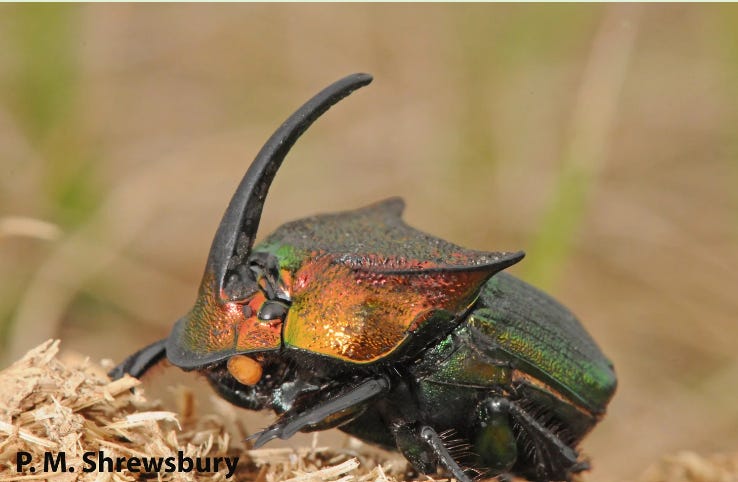
This tiny triceratops uses its horn for the same reason the dinosaurs did – to fight off other males. Believe it or not, dung rolling is a competitive field and beetles have been known to attack and steal each other’s prize dung balls.
Not all dung beetles are rollers – some just tunnel in or live under poop. Go to any cow or horse pasture and you’re likely to see beetles under and around the cow patties chomping down. Or, if you want to help take care of dog poop in your yard, for $100 you can buy a box of 400 dung beetles and have them shipped to you.
What are the beetles doing with all this dung? Well, they are literally eating it. There are a lot of nutrients left in our waste and the beetles, as nature’s decomposers and recyclers, are making the most of it. The rollers, like the dung beetle I saw, will move a chunk off site to their burrow to serve as food storage or as a brooding ball, where the female lays her eggs.
The beetles can roll these balls an impressively long way. They’ve been tracked pushing the balls over 200 meters – the length of two football fields! Pretty impressive, considering the beetles are just a few centimeters long and walking backwards the whole time.
The taurus scarab, which lives in Europe but was introduced to the U.S. to help control cow dung, is known for its strength. It can pull 1, 141 times its own weight. That’s the equivalent of a human pulling six double-decker buses filled with people.

Even more impressive? Dung beetles roll their prizes in very straight lines, even navigating around obstacles to stay oriented to their final destination.
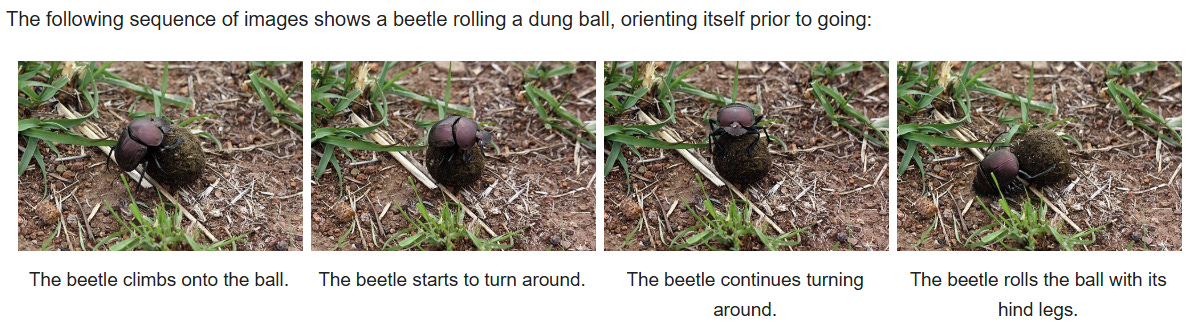
How do they do it? They use the position of the sun or, at night, moonlight to orient themselves towards home. The African dung beetle Scarabaeus satyrus actually navigates using light from the Milky Way. Think about that for a moment – this tiny insect, whose compound eyes are just a few centimeters off the ground, can sense the light of the stars millions of miles away.
No wonder dung beetles were highly regarded by the ancient Egyptians. The morning sun god Khepri is oftentimes represented as a scarab beetle because he was believed to push the sun across the sky using a solar sailing vessel in much the same way these beetles push their dung balls across vast distances.
Regardless of the fact that these beetles live in, handle, and even eat poo, you have to admit they’re impressive little guys and gals. A human might sneer at a life spent on so menial a task, and yet it’s a useful and necessary one. And perhaps looking forward at the past with the future invisible over our shoulders is the saner, more liberating way to live.
Weird Nature:
(click to watch)

Fascinating, dung beetles are so cool!
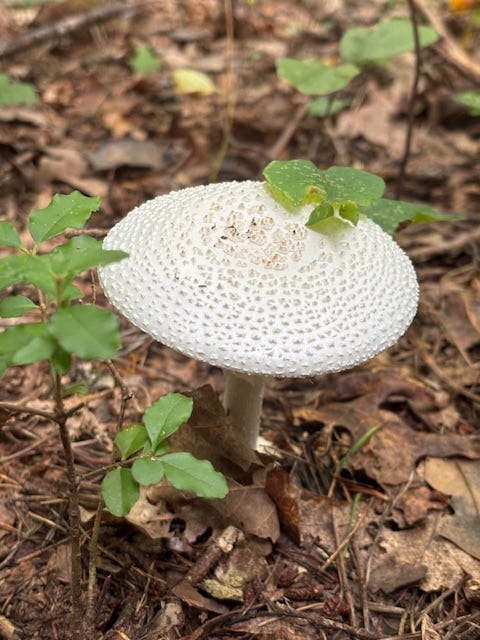
I don't think your mushroom is a destroying angel though. It looks like a member of the genus Amanita, to which destroying angels belong, but destroying angels don't have warty caps. There are, however, several species of destroying angel in Georgia and at least one seems fairly common, according to iNaturalist. With decent medical treatment, the death rate is more like 10% rather than 50%, but it's still very dangerous. Definitely don't go munching on random mushrooms (although touching them isn't dangerous).
Apologies for the ramble, I have a long-standing interest in toxic fungi and plants, and interviewed an expert on them earlier this year.
Great story. I am a Marine, Viet Nam Combat Vet. I ran across this dung beetle daily. Every time I would defecate. I saw the beetle. I did not notice it at first. The first time I noticed it was the ground started to move. I watch and low and behold the beetle started pulling it under the ground. I guess the beetle was always underground. I vaguely remember what it looked like. Just black. It was interesting to watch it do its job. They must be all over Viet Nam. I am not sure if this happened every time. But, enough for me to garner my interest. It was funny to watch. It did not take them long to do their job. Heather, I don't recall seeing them on level ground. Thank for the information.
Allen Hahn